

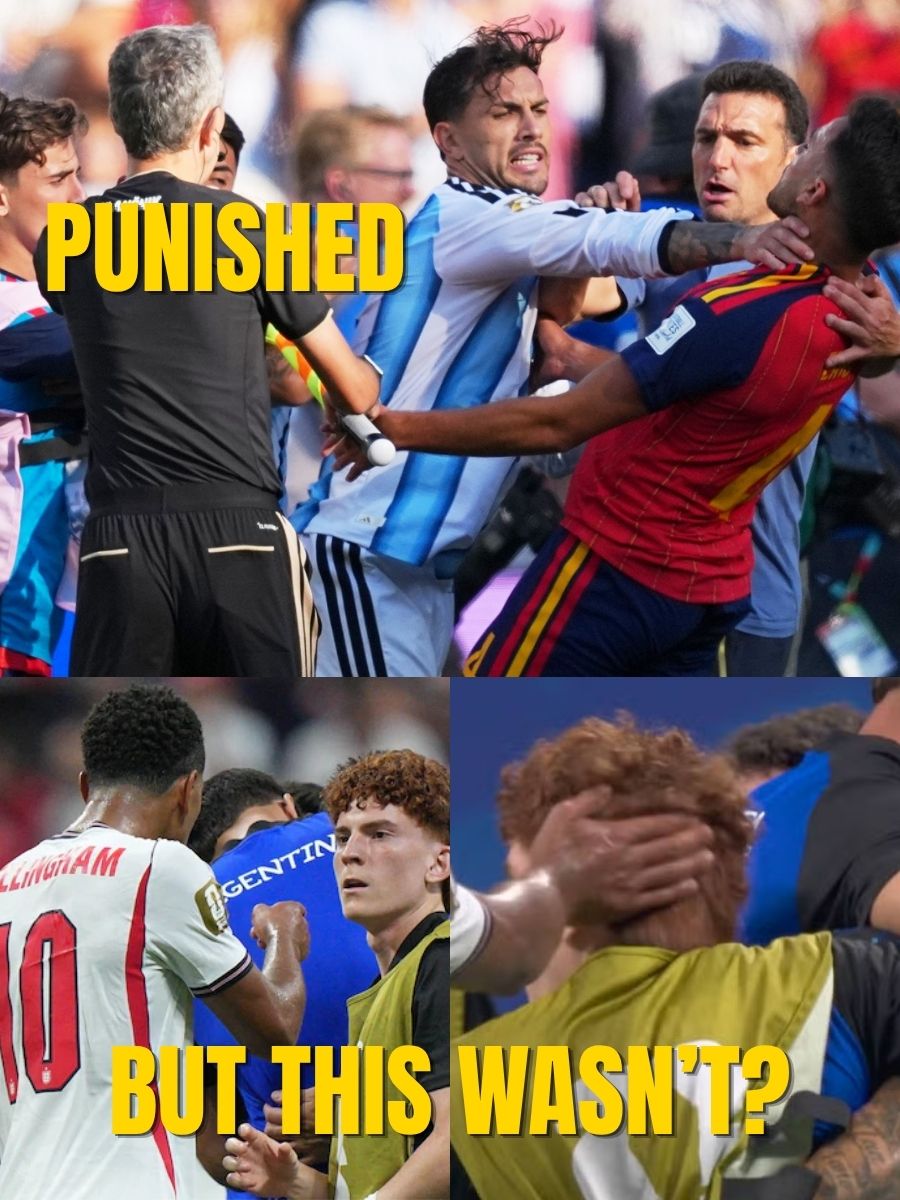
FIFA has handed down major punishments to Argentina following the 2026 World Cup, but the absence of any publicly announced sanction against Jude Bellingham for striking Valentín Barco raises legitimate questions about consistency.
Argentina’s controversial end to the 2026 FIFA World Cup has resulted in significant disciplinary action.
Leandro Paredes has been suspended for 10 international matches and fined US$90,000, while Nahuel Molina received a seven-match ban and US$90,000 fine following the confrontation after Argentina’s World Cup final defeat to Spain.
Thiago Almada received a one-match suspension, Argentina assistant coach Roberto Ayala was banned for three matches, while Spain midfielder Gavi was also suspended for one match.
Nobody should be above the rules.
If Argentina’s players crossed the line, they should face appropriate consequences.
But that raises an important question:
What Happened to Jude Bellingham’s Slap on Valentín Barco?
Following Argentina’s 2-1 World Cup semi-final victory over England, footage showed England midfielder Jude Bellingham striking Valentín Barco on the back of the head during the post-match scenes.
The incident was significant enough to attract international media attention.
Additional footage later provided more context to the confrontation, including apparent provocation during Argentina’s celebrations.
But provocation and retaliation are two different issues.
Provocation may explain why a player reacted. It does not automatically excuse physically striking an opponent.
And this is where FIFA’s disciplinary response deserves scrutiny.
While Argentina’s actions following the World Cup final resulted in suspensions and substantial fines, no comparable sanction against Bellingham over the Barco incident has been publicly announced.
That difference creates an unavoidable question about how the rules are being applied.
This Isn’t About Defending Argentina — It’s About Consistency
Paredes’ actions following the World Cup final were more serious than the Bellingham-Barco incident.
That distinction matters.
This is therefore not an argument that Bellingham should automatically receive the same punishment as Paredes, nor is it an argument that Argentina’s players should escape responsibility.
It is much simpler than that.
Similar disciplinary principles should be applied consistently.
If post-match physical aggression can be reviewed retrospectively using video evidence, then a clearly documented incident involving an England player striking an Argentine opponent should reasonably face the same level of scrutiny.
The punishment can — and should — reflect the severity of each individual offence.
But the standard of accountability should not change depending on the player or the country involved.
Same World Cup. Same Rules?
Argentina has certainly not escaped punishment.
Paredes: 10 matches.
Molina: 7 matches.
Almada: 1 match.
Ayala: 3 matches.
Argentina’s federation has also received substantial financial sanctions connected to other incidents during the tournament.
Meanwhile, the Bellingham-Barco confrontation was captured on video, reported internationally and debated publicly.
Yet there has been no publicly announced FIFA sanction against Bellingham over the incident.
That contrast matters.
Argentina Can Be Wrong — And FIFA Can Still Be Questioned
Football debate often forces everything into two camps.
Either Argentina must be completely defended, or every disciplinary decision against Argentina must be accepted without question.
Both positions miss the point.
Argentina’s players can be wrong for their actions AND FIFA can still be questioned over apparent inconsistencies in enforcement.
Those ideas are not contradictory.
Argentina should answer for Argentina’s actions.
Spain should answer for Spain’s actions.
England should answer for England’s actions.
The same principle should apply to everyone.
Because ultimately this debate isn’t about protecting Argentina.
It is about protecting the credibility of the rules.
If football’s disciplinary system is going to command respect, supporters need confidence that incidents are judged according to what happened — not according to the badge, reputation or nationality of the player involved.
Until comparable incidents are seen to receive comparable scrutiny, questions about consistency will remain legitimate.
What do you think? Was FIFA right to punish Argentina — and should the Bellingham-Barco incident also have resulted in disciplinary action?
Opinion | EXTV
